
Investigators Recover Black Boxes from Deadly UPS MD-11 Plane Crash in Louisville

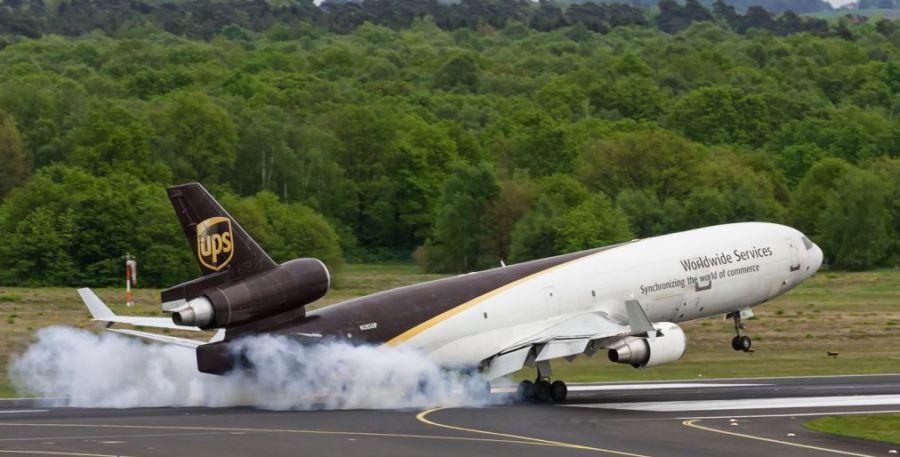
Federal investigators have recovered both flight recorders from the wreckage of the UPS cargo plane that crashed and exploded during takeoff from Louisville Muhammad Ali International Airport on Tuesday evening, killing at least 12 people. The National Transportation Safety Board (NTSB) confirmed Wednesday that the cockpit voice recorder and flight data recorder were found intact despite the intense fire that followed the crash.
NTSB Board Member Todd Inman said preliminary evidence indicates the left wing of the McDonnell Douglas MD-11 caught fire and that one of the aircraft’s three engines detached during takeoff. “We feel comfortable that once we get these to our lab in Washington, D.C., we’ll be able to get a good readout of the data,” Inman told reporters. “That will be another crucial step in helping us understand what happened.”
The 34-year-old MD-11 freighter, bound for Honolulu with three crew members aboard, crashed shortly after lifting off Runway 17R, striking several structures beyond the airport perimeter. The impact triggered a massive fireball that set off explosions at nearby industrial sites, including a petroleum recycling facility, and left a debris field stretching nearly half a mile through an industrial corridor.
Kentucky Governor Andy Beshear declared a state of emergency to accelerate disaster response efforts. Louisville Mayor Craig Greenberg confirmed that at least nine people on the ground were killed, in addition to the three crew members on board, bringing the total fatalities to 12. Several people remain unaccounted for, and at least 11 others were hospitalized with serious injuries.
More than 200 firefighters and emergency personnel battled the inferno through the night, supported by 50 fire trucks. Despite the widespread blaze, officials said nearby facilities, including a convention center, a restaurant, and a Ford Motor Company plant, were spared. The airport was temporarily shut down, halting operations at UPS’s Worldport hub, the company’s primary global air cargo facility, before limited service resumed early Wednesday Nov. 5.
UPS later confirmed that package-sorting operations were restarting and that the company aimed to restore its network “to a normal cadence” by Thursday morning. “Our goal is to begin returning the network to a normal cadence with flights arriving at destinations Thursday morning,” a UPS spokesperson said.
Investigators have not yet determined what caused the engine separation or fire, but early video evidence showed flames erupting from the left side of the aircraft moments before impact. Aviation safety expert Anthony Brickhouse said the NTSB will focus on the engine failure and its effect on the MD-11’s structural integrity and flight control systems. “It is designed to fly if you lose one engine, but we need to see the effect of losing that engine on the rest of the aircraft,” he said.
Boeing, which acquired McDonnell Douglas in 1997, and GE Aerospace, the manufacturer of the MD-11’s engines, have both pledged technical assistance to the investigation. The aircraft model, retired from passenger service in 2014, remains in operation as a freighter with about 50 still active worldwide, primarily with FedEx and UPS.
The NTSB expects to release a preliminary report within 30 days, though the full investigation and determination of probable cause could take up to two years. This marks the first fatal UPS air crash since August 2013, when a UPS Airbus A300 crashed on approach to Birmingham-Shuttlesworth International Airport in Alabama, killing both pilots.
Related News: https://airguide.info/?s=UPS, https://airguide.info/?s=MD-11, https://airguide.info/category/air-travel-business/travel-health-security/
Sources: AirGuide Business airguide.info, bing.com, reuters.com