
NTSB: Boeing Flagged MD-11 Engine Mount Risk Years Before UPS Crash

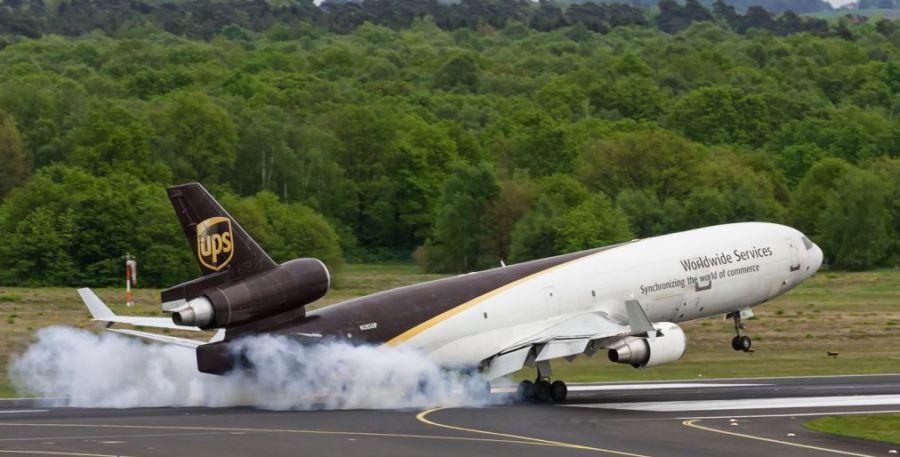
The National Transportation Safety Board has disclosed that Boeing warned airlines as early as 2011 about a critical MD-11 engine-mount component that ultimately failed in last year’s deadly UPS cargo crash—but concluded at the time that even a worst-case failure would not pose a safety-of-flight risk.
In a mid-investigation update released Jan. 14, the NTSB said a February 2011 Boeing service letter identified a bearing race within the MD-11’s engine-to-pylon mounting assembly as susceptible to fatigue cracking. The letter cited four failures on three different aircraft, all involving a collar-like spherical bearing race that cracked and split around its circumference.
“Specifically, each failure had initiated at the design recess groove on the interior surface of the bearing race,” the NTSB said. Despite these findings, Boeing determined at the time that the issue would not result in a safety-of-flight condition, recommending only repetitive inspections rather than mandatory replacement.
Investigators have now confirmed that the same failure mode occurred on the No. 1 (left) engine of the UPS MD-11 that crashed last November. Still images from airport security footage show the left engine separating from the aircraft and traveling up and over the wing as the jet rotated for takeoff.
The Boeing service letter instructed operators to inspect the bearing during routine pylon mount inspections—typically every 60 months—and updated the MD-11 maintenance manual accordingly. Boeing also recommended a redesigned bearing without the internal groove, but did not prohibit replacing a failed grooved bearing with another of the same design if deemed airworthy.
The findings have drawn comparisons to the 1979 American Airlines Douglas DC-10-10 crash in Chicago, in which an engine separated during takeoff, killing 273 people. The MD-11’s design is derived from the DC-10, building on its basic airframe architecture while incorporating aerodynamic refinements, updated systems, and a modernized cockpit. Former FAA and NTSB investigator Jeff Guzzetti said it is notable that similar bearing failures were once classified as safety-critical, questioning why the 2011 Boeing notice did not carry the same urgency.
The NTSB said investigators are now reviewing whether UPS incorporated the inspections into its maintenance program, as well as the correspondence history between Boeing and the FAA leading up to the 2011 guidance. Boeing assumed responsibility for the MD-11 fleet after acquiring McDonnell Douglas in 1997.
The accident occurred on Nov. 4, 2025, when UPS Flight 2976 suffered engine separation during takeoff from Louisville Muhammad Ali International Airport. The aircraft climbed to only about 100 feet before crashing roughly 0.5 nautical miles from the runway into an industrial area. All three crewmembers and 11 people on the ground were killed.
Following the crash, Boeing urged operators to ground MD-11 aircraft, a step later mandated by the FAA.
While the investigation is ongoing, the NTSB’s update raises renewed questions about inspection intervals, aging aircraft design risks, and the limits of non-mandatory service letters—issues likely to influence both regulatory action and future litigation once the final report is released.
Related News: https://airguide.info/?s=boeing, https://airguide.info/?s=MD-11, https://airguide.info/?s=UPS, https://airguide.info/category/air-travel-business/travel-health-security/
Sources: AirGuide Business airguide.info, bing.com, aviationweek.com