
NASA Tests Blockchain to Strengthen Aviation Data Security

In response to growing cybersecurity risks in aviation, NASA is developing and testing blockchain-based technology designed to enhance the safety, integrity, and security of air travel data.
During a recent drone flight test at NASA Ames Research Center in California’s Silicon Valley, NASA researchers evaluated a decentralized blockchain system aimed at protecting flight data exchanged between aircraft and ground stations. The goal is to prevent disruption to air traffic management systems and reduce the risk of data being intercepted, altered, or corrupted.
For modern aviation and airspace operations, trust in data accuracy and transparency is essential. While existing systems provide robust protection, cyberthreats continue to evolve in sophistication and scale. NASA said its tests demonstrated that a blockchain-based approach can securely transmit and store flight-related information in real time, offering a potential new layer of resilience.
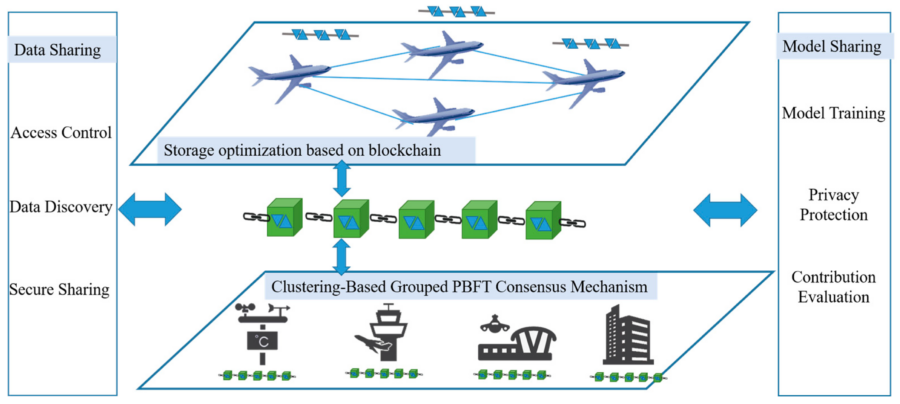
Blockchain technology functions as a distributed digital ledger, removing reliance on a single centralized database. Instead, data is shared across a network of authorized users, with every transaction recorded, verified, and time-stamped. This structure makes unauthorized data manipulation significantly more difficult and improves traceability and trust.
Unlike earlier cybersecurity research that emphasized layered physical and digital defenses, NASA’s experiment explored how blockchain itself could directly mitigate threats. By decentralizing data verification and access control, the system reduces single points of failure that could otherwise be exploited.
The use of drones allowed researchers to demonstrate the framework’s relevance across multiple priority aviation domains, including autonomous air traffic management, Urban Air Mobility, and high-altitude aircraft operations. NASA said the results suggest the approach could scale beyond small unmanned aircraft to more complex airspace environments.
For the test, researchers used an open-source blockchain framework that enables trusted users to securely share and store sensitive data such as aircraft registration details, flight plans, and real-time telemetry. Access is restricted to approved participants, ensuring that only authorized operators can view or modify information.
To evaluate system resilience, the team conducted a series of cybersecurity stress tests during operations. In an August demonstration flight at Ames, the blockchain system was integrated into an Alta-X drone equipped with custom software and hardware, including onboard computing, radio communications, GPS, and power systems. The scenario simulated real-world operations with a separate ground control station linked through the blockchain infrastructure.
NASA said the underlying framework and security protocols could be extended to support high-altitude operations above 60,000 feet, as well as future urban air mobility services, helping to build a more secure and scalable aviation ecosystem.
Researchers will continue analyzing data from the tests and applying the findings to future projects. The work is expected to benefit US aviation stakeholders seeking advanced tools to safeguard increasingly digital airspace operations.
The research was conducted under NASA’s Air Traffic Management and Safety project, part of the agency’s Airspace Operations and Safety Program within the Aeronautics Research Mission Directorate, which focuses on enabling safe, efficient, and innovative aviation systems for the public and industry alike.
Related News: https://airguide.info/?s=NASA, https://airguide.info/category/air-travel-business/artificial-intelligence/, https://airguide.info/category/air-travel-business/travel-health-security/
Sources: AirGuide Business airguide.info, bing.com, nasa.gov