
China Eases Runway Rules to Boost Comac C919 Rivalry With Airbus and Boeing

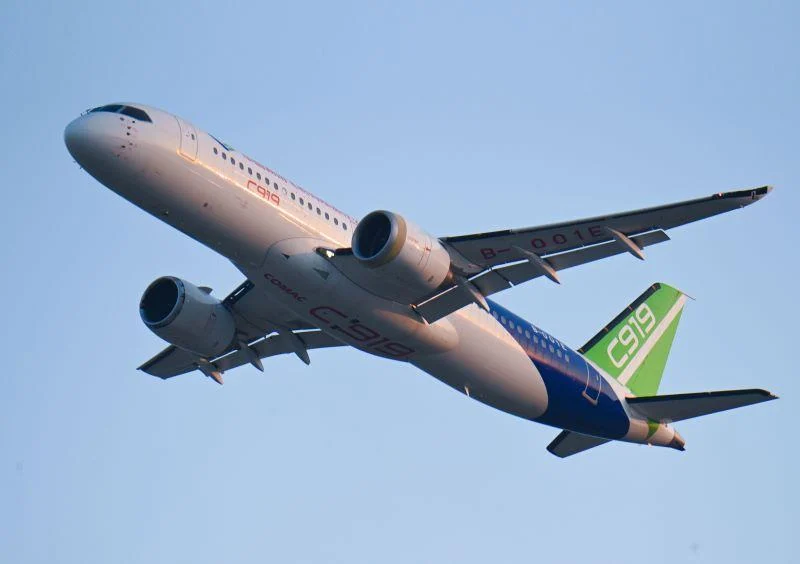
China is moving to adjust aviation regulations in a bid to strengthen the competitiveness of its domestically developed C919 narrowbody jet, potentially opening the door to wider use at smaller airports and improving its prospects in Southeast Asia.
At the Singapore Airshow this week, Comac scored a six-unit order for its C909 regional jet, albeit on this occasion in an aerial fire-fighting guise.
The Civil Aviation Administration of China said that it has set out “special conditions” that would allow the C919 to operate from narrower runways than originally specified. The regulator released a draft proposal for public consultation, with a 10-working-day comment period, outlining revised technical and safety requirements tailored to the aircraft’s design.
The C919, developed by state-owned Commercial Aircraft Corporation of China, was initially certified for runways with a minimum width of 45 metres, a standard typical of major international airports. Under the proposed change, the minimum runway width could be reduced to 30 metres, a move the regulator said is intended to “meet market demands” while maintaining safety margins.
If implemented, the change would allow the C919 to operate at a far larger number of airports across China, including regional and general aviation facilities that use narrower runways. It would also align the aircraft more closely with competing models from Boeing and Airbus, whose 737 and A320 family jets are already certified for operations on such runways.
Configured for up to 192 seats, the C919 is designed to compete directly with the Boeing 737 and Airbus A320 families. According to independent aviation analyst Li Hanming, the regulatory change would allow the Chinese jet to “enter some markets previously dominated by the Boeing 737 and Airbus A320,” particularly where airport infrastructure has limited runway width.
Positioning and Capabilities of the C919
The C919 has been in commercial service since 2023 and is currently operated exclusively by Chinese airlines. At least 18 aircraft are in service on 24 routes connecting 16 cities across the country. Despite a growing domestic footprint, Comac has yet to secure confirmed export orders for the type.
Comac positions the C919 squarely in the A320/737 category. Powered by twin CFM LEAP-1C engines, it seats about 158 passengers in two classes or around 190 in a single-class layout and is offered in both standard and extended-range versions. Published figures show a standard range of about 4,000 km and an extended range of 5,500–5,600 km, with a typical cruise speed near Mach 0.78. This places the C919 within striking distance of most A320neo and 737 Max missions, though short of the longest A321LR and XLR segments. By combining a proven Western powerplant with an A320-like airframe, Comac delivers familiar economics to airlines and lessors while working toward greater component localization.
Still, price may remain Comac’s strongest lever. If the C919 is sold 10–20% below comparable A320neo models, cost-conscious carriers across Asia, Africa, and Latin America may see it as a compelling option amid rising demand for affordable capacity. The scenario is not without precedent—Airbus faced similar skepticism when it entered the market in the 1970s, only to evolve into Boeing’s main rival. Decades later, its A320 family has even surpassed the 737 in total global sales, suggesting Comac could follow a comparable trajectory if it sustains quality, reliability, and scale.
Analysts say access to narrower runways could help the aircraft accumulate operational experience and improve its appeal to overseas carriers, especially in Southeast Asia, where smaller airports are common. Aircraft from Airbus and Boeing already serve destinations such as Coron in the Philippines and Dili in Timor-Leste, where runway width and manoeuvring space can be limiting factors.
Comac is showcasing both the C919 and the smaller C909 regional jet at the Singapore Airshow as it seeks to challenge the long-standing Airbus-Boeing duopoly. While the C909 is already flying with several Southeast Asian operators, it remains limited to niche markets.
Production remains a key focus for Comac. China’s three largest airlines have each ordered 100 C919s, and the manufacturer is expected to deliver at least 28 aircraft this year, up from 15 in 2025, as it works to scale up output and prepare for potential international expansion.
Related News: https://airguide.info/?s=Comac+C919
Sources: AirGuide Business airguide.info, bing.com, scmp.com