
Flight Cuts Surge Across Middle East Airlines

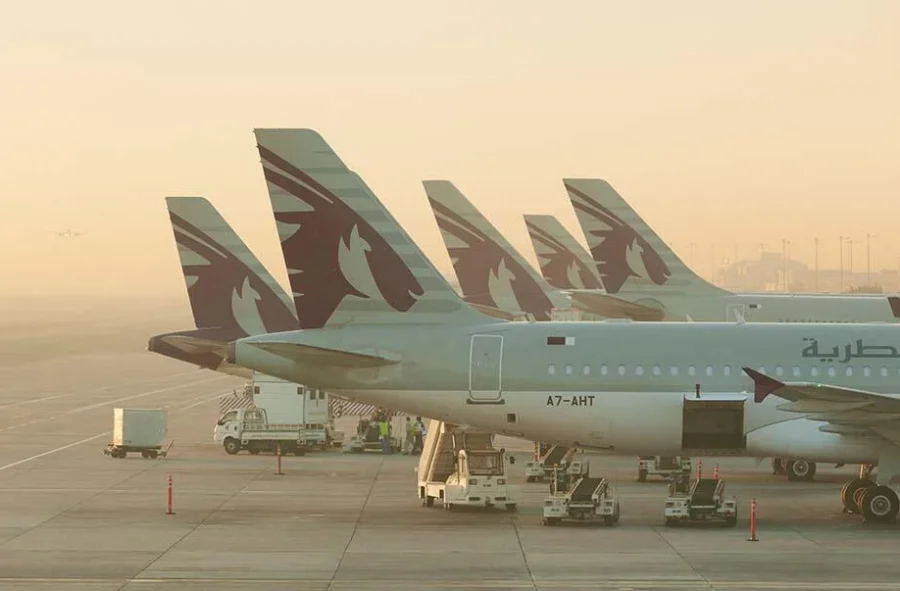
Middle Eastern airlines are accelerating short-term suspensions and capacity reductions as escalating conflict disrupts one of the world’s most critical aviation corridors, although most carriers continue to avoid making long-term network adjustments.
For now, airlines are largely maintaining published schedules and operating flights where feasible, rather than committing to structural reductions. However, forward planning has slowed sharply, with few new route announcements into the region as uncertainty over the duration of the disruption continues to weigh on airline strategy.
The impact is most pronounced among Gulf carriers, whose hub-and-spoke models rely heavily on uninterrupted transfer traffic. Major hubs such as Dubai, Doha, and Abu Dhabi collectively handle hundreds of thousands of passengers daily, with a significant share connecting between Europe, Asia, and Africa. Any disruption to regional airspace quickly reverberates across global networks.
Qatar Airways has confirmed it will operate a reduced network between March 18 and March 28, focusing on key long-haul routes including London Heathrow, Paris, Bangkok, and Tokyo Narita. The move reflects a broader strategy to protect core markets while scaling back less essential services.
Emirates and Etihad Airways have also trimmed operations but continue to operate approximately 90% of their planned schedules as of mid-March. This suggests that while disruptions are material, airlines are prioritizing network stability and connectivity as long as conditions allow.
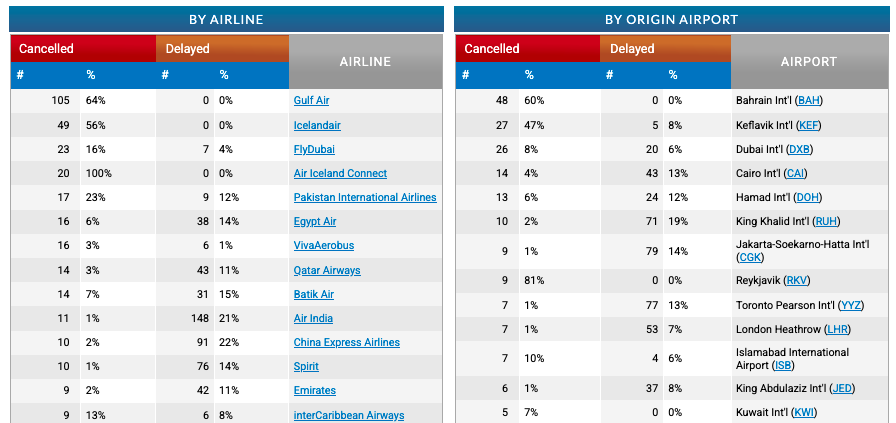
FlightAware — Airport Delay Map with Delay List & Flight Live Tracker
See live delay and cancellation status for airports worldwide; useful for spotting current delays that might be influenced by staffing, weather, or traffic volume.
Flights Cancelled Today: https://www.flightaware.com/live/cancelled/today
Elsewhere in the region, operational challenges are more severe. The closure of Bahraini airspace has forced Gulf Air to suspend standard operations at its home hub, with limited services temporarily relocated to Dammam in Saudi Arabia. Kuwait has also experienced significant disruption, with Jazeera Airways shifting operations to Al Qaisumah and transporting passengers across the border by ground. Kuwait Airways has largely suspended services.
Iranian carrier Mahan Air continues to operate a limited international network, including flights between Tehran and Shanghai, while filing an adjusted interim schedule covering destinations such as Dubai and Istanbul despite ongoing airspace restrictions.
Although these changes are not yet fully reflected in published schedules, the aviation industry is entering a period of heightened operational uncertainty. If tensions persist, airlines are likely to implement deeper capacity reductions and more permanent network shifts, potentially reshaping air traffic flows across the Middle East and beyond.
Related news: Live Tracker: Airport and Flight Delays Today, https://airguide.info/category/destinations/travel-tips/, https://airguide.info/category/magazineonline/airlines/, https://airguide.info/category/magazineonline/airports/