
Europe’s EASA Warns of Aviation Risks as Airspace Corridors Tighten

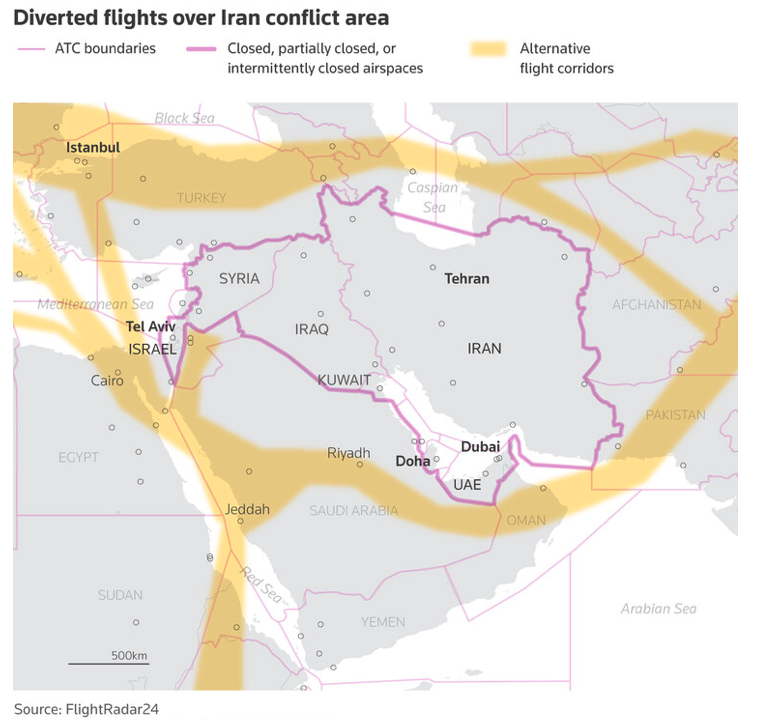
Europe’s top aviation safety regulator has warned that escalating global conflicts, particularly the ongoing Iran war, are increasing safety risks as airlines are forced into narrower and more congested flight corridors.
The European Union Aviation Safety Agency (EASA) said on Mar. 27 that multiple conflicts, from the Middle East to Eastern Europe and South Asia, are reshaping global airspace, concentrating traffic into limited routes and creating new operational challenges for pilots and air traffic controllers.
According to EASA Executive Director Florian Guillermet, the compression of air traffic into fewer corridors is raising concerns about safety and airspace management. “Concentrating traffic on certain routes, combined with limited airspace availability and the use of less familiar routings, can generate safety risks,” he said.
The month-long conflict involving Iran has significantly disrupted one of the world’s most critical aviation regions, affecting major east–west routes linking Europe and Asia. Airlines are increasingly avoiding airspace over Iran, Iraq, Israel, and surrounding areas, forcing flights to reroute through alternative corridors over Central Asia and the Caucasus.
These pressures are compounded by the ongoing Russia-Ukraine conflict and instability in parts of South Asia, which have already reduced available airspace and extended flight times on key intercontinental routes.
Beyond congestion, EASA highlighted growing risks from drones and military activity in conflict zones. The increasing presence of unmanned aerial systems, combined with missile threats and GPS interference, is adding complexity to flight operations and elevating the risk profile for commercial aviation.
Despite these challenges, Guillermet emphasized that the aviation industry has tools to manage risk, including rerouting and temporary airspace closures. “One of the most effective ways to mitigate risk is to clear the skies,” he said, noting that while such measures can disrupt passengers and schedules, they remain essential for maintaining safety.
EASA, which oversees aviation safety across 31 European countries, is currently reviewing its broader safety strategy to address emerging threats. These include not only geopolitical risks but also operational hazards such as unstable approaches, runway incursions, and increasing traffic density in constrained airspace.
The agency has extended its advisory for airlines to avoid flying over Iran, Israel, and parts of the Gulf region through at least April 10, underscoring the ongoing uncertainty.
As global conflicts continue to reshape airspace access, aviation authorities and airlines face mounting pressure to balance operational efficiency with safety, in what is becoming an increasingly complex and unpredictable flying environment.
Related News: https://airguide.info/?s=iran, https://airguide.info/?s=EASA, https://airguide.info/category/air-travel-business/travel-health-security/
Sources: AirGuide Business airguide.info, bing.com, reuters.com