
Artemis II Countdown Enters Final Hours for Lunar Voyage

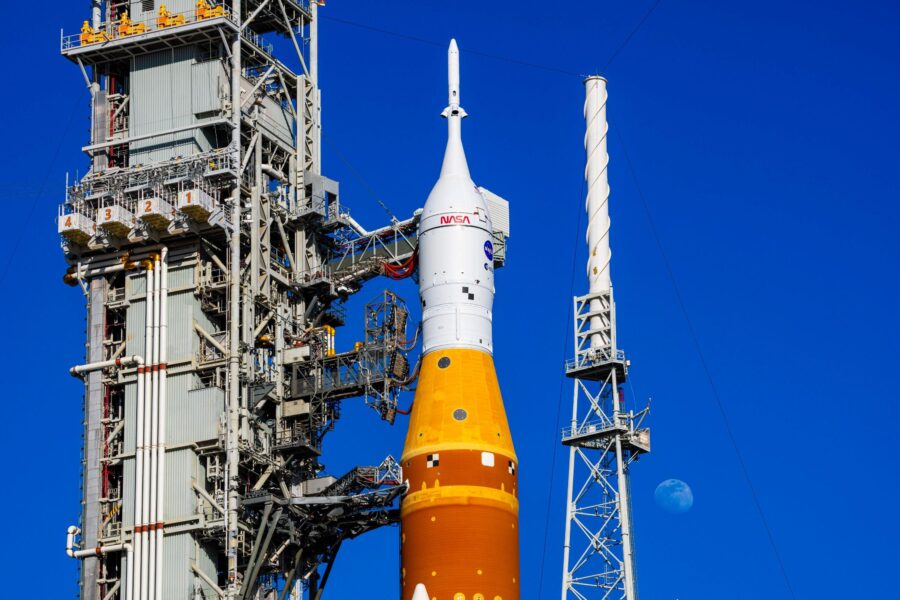
As of Wednesday, April 1, 2026, NASA is in the final countdown for the highly anticipated Artemis II launch, targeting liftoff at 6:24 p.m. EDT from Kennedy Space Center Launch Complex 39B. The mission marks a major step forward in human space exploration, serving as the first crewed test flight of the Orion spacecraft under the Artemis program.
Having witnessed, as a teenager in the mid to late 1960s, the Mercury program, Gemini program, and Apollo program with great excitement, it sparked my lifelong interest in pursuing a career in aviation and aviation history. I am delighted to see that we are returning to the Moon, this time with the clear intent of staying and establishing a sustained human presence at the lunar south pole.
Although often compared to Apollo 8, Artemis II is significantly more advanced, designed to validate modern deep-space systems and ensure Orion can safely support astronauts during extended missions beyond low Earth orbit.
The mission will run from April 1 to April 10, following a carefully structured flight profile. After launch aboard the Space Launch System, Orion will first enter a highly elliptical Earth orbit using its Interim Cryogenic Propulsion Stage. During this initial phase, the crew will spend approximately 24 hours conducting critical checks on life support, navigation, and communication systems.
It took NASA just eight years to go from putting its first astronaut in space to putting Apollo 11’s Neil Armstrong and Buzz Aldrin on the moon in 1969, beating President John Kennedy’s end-of-decade deadline. “The Apollo program still just absolutely blows me away,” said Artemis II astronaut Jeremy Hansen of the Canadian Space Agency,
Artemis has progressed much more slowly, after decades of indecision and flip-flopping between the moon and Mars as the next grand destination. NASA’s new moon rocket, the Space Launch System, or SLS, has soared only once in a test flight without anyone on board more than three years ago.
A key innovation in Artemis II is a proximity operations test. Unlike Apollo missions, the crew will manually maneuver Orion near the spent upper stage, simulating docking procedures required for future lunar landings. This “test drive” is essential for validating techniques that will be used in later Artemis missions involving lunar orbit rendezvous.
Moon rocket
Apollo’s Saturn V rockets stood 363 feet (110 meters), with five first-stage engines. The Artemis SLS rocket comes in at 322 feet (98 meters) but packs more liftoff thrust with its four main engines and two strap-on boosters.
All but one Saturn V rocket soared from Kennedy Space Center’s Launch Complex 39-A, now leased by SpaceX. NASA will use neighboring pad 39-B for all SLS flights. While the Saturn V launched twice before carrying astronauts, the SLS has flown only once. Hydrogen fuel leaks delayed the SLS debut in 2022 and struck again during a countdown test in February, stalling Artemis II. Then helium trouble reappeared, causing further delay. NASA is now targeting an April liftoff.
Launch Control remains at the same place. There was one woman in the packed firing room for the liftoff of Apollo 11. Now a woman leads it: Artemis launch director Charlie Blackwell-Thompson.
NASA Artemis moonshot
Three Americans and a Canadian will zip around the moon in the first astronaut lunar trip in a half-century.
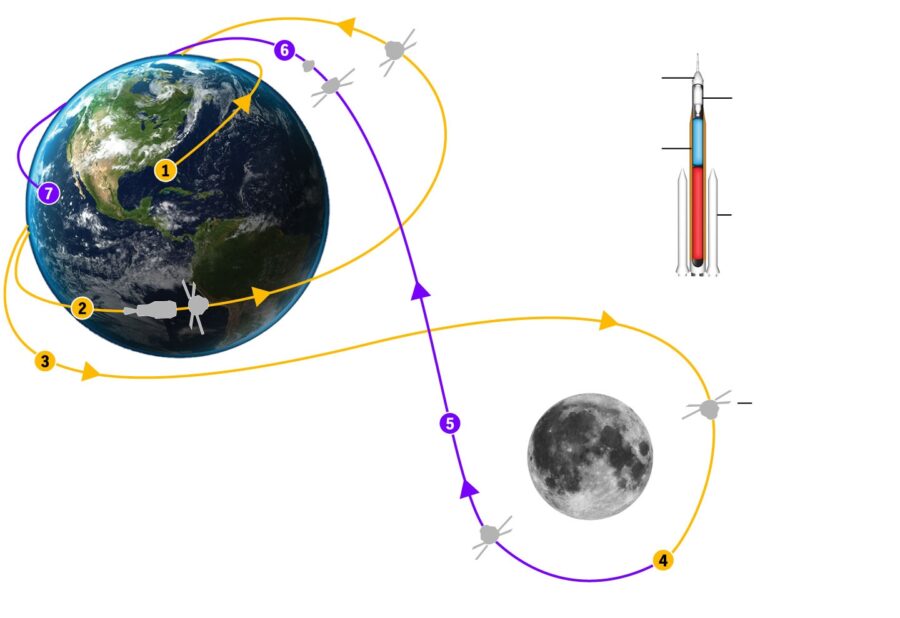
The mission will then transition into its deep-space phase. A second engine burn will send Orion on a free-return trajectory around the Moon, allowing the spacecraft to loop behind the lunar far side before naturally returning to Earth. During this phase, the crew will travel approximately 4,700 miles beyond the Moon’s surface.
Artemis II is also expected to set a new human spaceflight distance record. On April 6, the crew will surpass the benchmark set during Apollo 13, venturing farther from Earth than any humans in history.
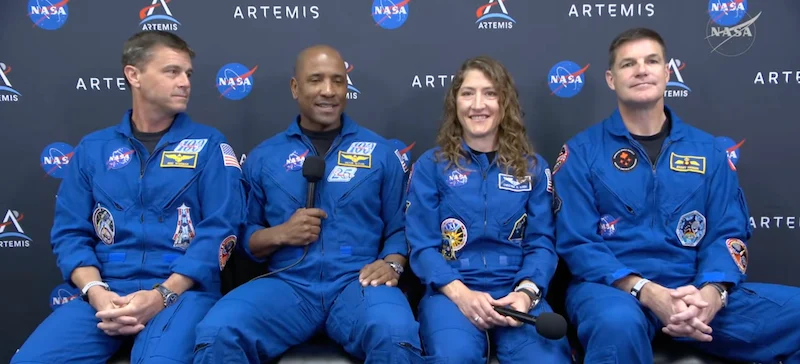
The crew reflects a new era of diversity in space exploration. Commander Reid Wiseman, a former Navy captain, brings extensive International Space Station experience. Pilot Victor Glover made history on SpaceX Crew-1 as the first Black astronaut on a long-duration ISS mission. Mission Specialist Christina Koch holds the record for the longest single spaceflight by a woman, while Jeremy Hansen of the Royal Canadian Air Force becomes the first non-American to venture beyond low Earth orbit.
As the countdown reaches its final hours, Artemis II represents not only a technological milestone but also a defining moment in humanity’s return to deep space, paving the way for future lunar landings and eventual missions to Mars.
Related News: https://airguide.info/?s=NASA, https://airguide.info/?s=artemis
Sources: AirGuide Business airguide.info, bing.com, apnews.com