
Artemis Program: Key Companies Powering NASA’s Moon Mission

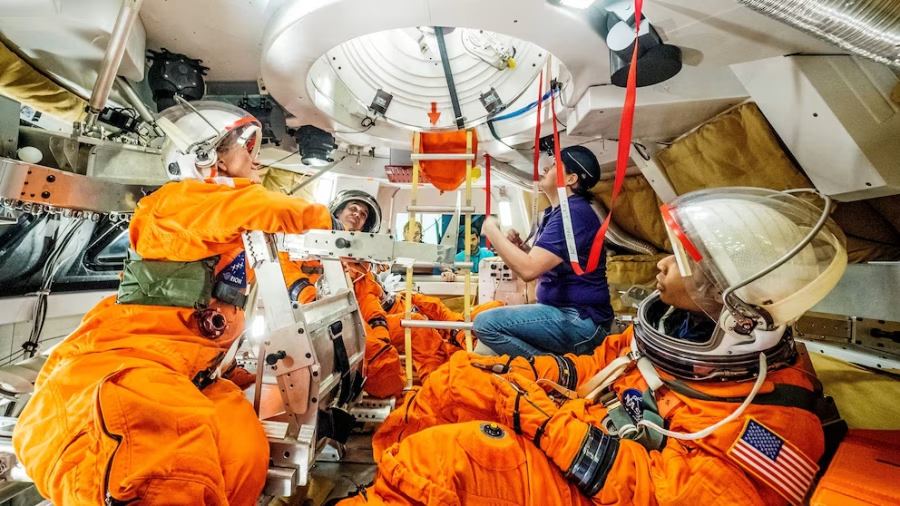
The Artemis program has evolved into one of the most complex industrial ecosystems in modern aerospace, combining government leadership with a vast global supply chain spanning more than 2,700 companies across all 50 U.S. states and multiple international partners. As of April 2026, the program is no longer just a lunar mission, it is a multi-layered infrastructure effort designed to establish a sustained human presence beyond Earth, anchored by the Space Launch System (SLS), the Orion spacecraft, and a new generation of lunar and orbital platforms.
“The Artemis program represents a new model for exploration, one that combines government leadership with industry innovation at an unprecedented scale,” said NASA officials, highlighting the role of commercial partners in accelerating deep-space capabilities.
At the core of this architecture is a tightly integrated group of prime contractors responsible for the mission’s critical flight systems. Lockheed Martin leads development of the Orion crew module, including life-support systems and the launch abort capability that ensures astronaut safety during ascent.
“We’re not just building a rocket or a spacecraft—we’re building an entire ecosystem for sustained exploration beyond Earth orbit,” a senior executive at Lockheed Martin said, referring to the integration of Orion, SLS, and future lunar infrastructure.
Boeing manufactures the SLS core stage and flight avionics, forming the structural and operational backbone of NASA’s heavy-lift rocket. Northrop Grumman supplies the solid rocket boosters, which generate roughly 75% of the thrust required at liftoff, as well as key propulsion elements for abort scenarios.
“The scale and complexity of Artemis requires seamless coordination across multiple primes and international partners, this is one of the most ambitious engineering collaborations ever undertaken,” noted an industry analyst familiar with Boeing and SLS development.
Complementing these U.S. systems, Airbus, through the European Space Agency, produces the Orion European Service Module, providing propulsion, electrical power, thermal control, and life-support consumables essential for deep-space missions.
“The European Service Module is a critical contribution that enables Orion to operate in deep space, this is a truly global mission,” said a spokesperson from Airbus, underscoring international collaboration.
Together, these contractors form the backbone of Artemis, integrating propulsion, crew systems, and mission-critical infrastructure into a single architecture capable of supporting sustained lunar exploration and future missions to Mars.
The “Big Four” Prime Contractors
These companies own the “heavy lifting” for the SLS rocket and the Orion spacecraft currently heading to the Moon:
- Lockheed Martin: The lead contractor for the Orion Crew Module. They built the capsule where the four astronauts are currently living and the Launch Abort System (LAS).
- Boeing: Responsible for the SLS Core Stage (the giant orange fuel tank) and the avionics that control the rocket’s flight.
- Northrop Grumman: Built the twin Solid Rocket Boosters (SRBs) that provide 75% of the thrust at liftoff. They also manufacture the abort motors for the Orion capsule.
- Airbus (on behalf of ESA): Built the European Service Module (ESM). This is the “powerhouse” attached to the bottom of Orion that provides electricity, propulsion, water, and air to the crew.
Beyond the launch system, the program’s next phase focuses on landing astronauts on the Moon. SpaceX is developing the Starship Human Landing System (HLS) for Artemis III and IV missions, designed to transport astronauts from lunar orbit to the surface. Blue Origin has also been selected to develop its Blue Moon lander, expanding competition and redundancy for future missions such as Artemis V.
The Lunar Landers (Human Landing System)
While Artemis II is a flyby, these companies are currently building the ships that will actually touch down on the surface in future missions:
- SpaceX: Developing the Starship HLS for Artemis III and IV.
- Blue Origin: Recently awarded a contract to develop the Blue Moon lander for the Artemis V mission.
In parallel, NASA and its partners are building the Lunar Gateway, a small space station that will orbit the Moon and serve as a staging point for surface missions. Maxar Space Systems is developing the Power and Propulsion Element (PPE), while Northrop Grumman is also constructing the HALO habitation module, where astronauts will live during lunar missions.
On the lunar surface, Axiom Space is designing next-generation spacesuits (AxEMU) that will support astronauts during moonwalks, marking the first human return to the lunar surface since 1972. Meanwhile, companies including Intuitive Machines, Lunar Outpost, and Venturi Astrolab are competing to build the Lunar Terrain Vehicle, a next-generation rover designed to enable extended exploration.
Lunar Gateway & Surface Infrastructure
For the mini-space station that will orbit the Moon and the gear used on the surface:
- Maxar Space Systems: Building the Power and Propulsion Element (PPE), the first piece of the Gateway station.
- Northrop Grumman: Also building the HALO (Habitation and Logistics Outpost) where astronauts will stay while in lunar orbit.
- Axiom Space: Developed the next-generation spacesuits (AxEMU) that will be used for the first lunar walk since 1972.
- Intuitive Machines / Lunar Outpost / Venturi Astrolab: These three companies are currently competing to build the Lunar Terrain Vehicle (LTV), the high-tech “moon buggy” for future missions.
Key Specialized Partners
- Aerojet Rocketdyne: Manufactures the RS-25 engines for the SLS and the main engine for the Orion capsule.
- Jacobs / Amentum: Managed the ground systems and the actual “stacking” and launch operations at Kennedy Space Center.
- MDA Space: The Canadian firm building Canadarm3, the AI-driven robotic arm for the Gateway.
- Teledyne Brown: Built the adapter that connects the Orion capsule to the SLS rocket.
Together, these companies form the backbone of NASA’s strategy to establish a sustainable human presence on the Moon, integrating launch systems, crewed spacecraft, and supporting infrastructure into a unified deep-space architecture. By combining government leadership with private-sector innovation, the Artemis program is not only enabling the return of astronauts to lunar orbit and the surface for the first time in more than five decades, but also building the operational, technological, and commercial foundation for long-term exploration. This includes developing reusable systems, lunar logistics, and orbital platforms such as the Gateway, all of which are critical stepping stones toward future crewed missions to Mars and deeper into the solar system.
Related News: https://airguide.info/?s=NASA, https://airguide.info/?s=artemis
Sources: AirGuide Business airguide.info, bing.com, nasa.gov