
Europe, Asia Airlines Cut Middle East Flights

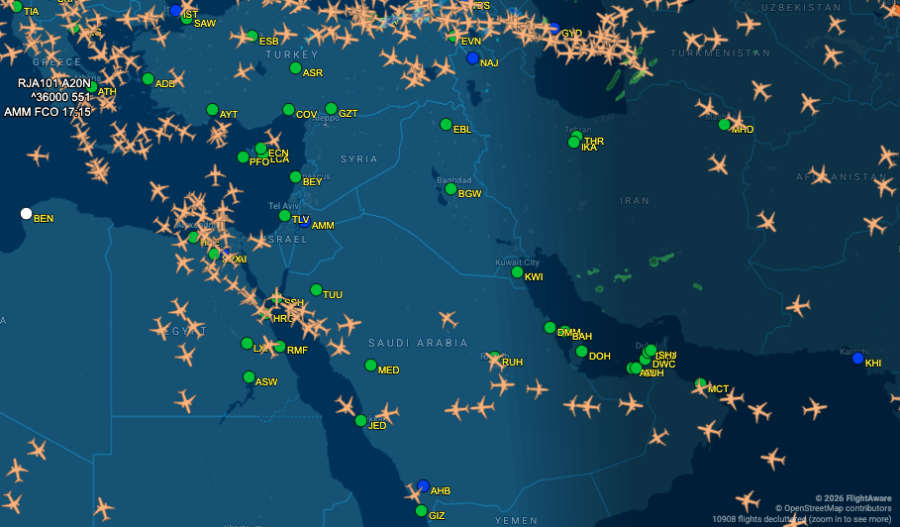
Airlines in Europe, India and Asia are accelerating short-term suspensions and capacity reductions as escalating conflict disrupts one of the world’s most critical aviation corridors. However, most carriers continue to avoid long-term network restructuring, opting instead for tactical adjustments as uncertainty persists. Here’s how the impact is unfolding by region.
European airlines have moved quickly to scale back Middle East operations. British Airways has extended suspensions to key destinations including Amman, Bahrain, Dubai, and Tel Aviv through the end of May, with additional pauses affecting Doha and Abu Dhabi. Lufthansa Group has also suspended multiple routes, including Dubai, Abu Dhabi, Amman, Erbil, and Beirut through March 28, Tel Aviv through April 2, and Tehran through April 30. KLM has similarly extended suspensions to Riyadh, Dammam, and Dubai through March 28.
Related news: Flight Cuts Surge Across Middle East Airlines
Israeli flag carrier El Al has taken even more drastic action, canceling a wide range of services between March 21 and March 27. These include flights to major European hubs such as London, Paris, Frankfurt, and Zurich, as well as several U.S. destinations, citing operational constraints at Tel Aviv Ben Gurion Airport.
In Asia, airlines are also adjusting networks. Cathay Pacific has suspended its Hong Kong–Riyadh service through the end of March, while Virgin Atlantic has withdrawn its London Heathrow–Dubai route for the remainder of the winter 2025–26 season.
FlightAware — Airport Delay Map with Delay List & Flight Live Tracker
See live delay and cancellation status for airports worldwide; useful for spotting current delays that might be influenced by staffing, weather, or traffic volume.
Flights Cancelled Today: https://www.flightaware.com/live/cancelled/today
At the same time, carriers are redeploying capacity to markets unaffected by the conflict in an effort to offset lost Middle East revenue and capture displaced demand. Lufthansa Group plans to add frequencies in the coming weeks, including four additional Munich–Singapore rotations and increased Frankfurt–Cape Town service. Austrian Airlines is boosting Vienna–Bangkok operations, while Air France is expanding long-haul capacity from Paris Charles de Gaulle with additional flights to Bangkok, Singapore, Delhi, Mumbai, and Nairobi.
India is emerging as a key beneficiary of this shift. Air India has announced 36 additional frequencies between March 19 and March 28, adding more than 10,000 seats on routes connecting New Delhi and Mumbai with major destinations such as London Heathrow, Frankfurt, Zurich, and Toronto.
The disruption underscores how dependent global air traffic flows have become on Gulf hubs for east–west connectivity. With airspace restrictions affecting traditional routes, airlines are being forced to rethink established patterns, even if only temporarily.
Despite the scale of disruption, long-term structural changes remain uncertain. Airlines face operational and commercial constraints that limit how quickly fleets and networks can be redeployed. For now, the focus remains on flexibility, with carriers making short-term adjustments while monitoring developments.
While demand is beginning to shift toward nonstop flights and alternative routings, the Gulf hub model is expected to remain resilient. Much will depend on how long the disruption continues—and how quickly stability returns to one of aviation’s most vital regions.
Related news: Live Tracker: Airport and Flight Delays Today, Flight Cuts Surge Across Middle East Airlines, https://airguide.info/category/destinations/travel-tips/, https://airguide.info/category/magazineonline/airlines/, https://airguide.info/category/magazineonline/airports/