
Iran Conflict Reshapes Global Air Travel and Hub Traffic

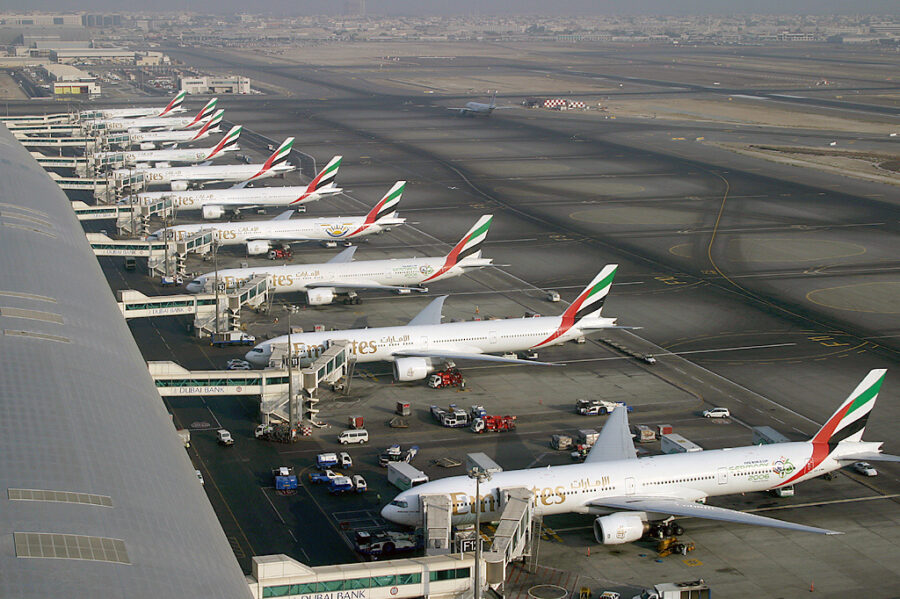
Global air travel is undergoing a profound realignment as geopolitical tensions linked to the Iran conflict reshape long-haul passenger flows between Europe, North America, and Asia. What began as airspace disruption across the Middle East is now accelerating a structural shift in how airlines route passengers, and which global hubs dominate intercontinental travel.
The Middle East has long served as the backbone of Europe–Asia connectivity, anchored by mega hubs such as Dubai, Doha, and Abu Dhabi. Dubai International alone handles approximately 95.2 million passengers annually, or nearly 7.9 million per month, while Hamad International in Doha processes 54.3 million annually. Jeddah, Riyadh, and Abu Dhabi collectively add tens of millions more passengers, reinforcing the region’s role as a global transit powerhouse.
Major Middle-Eastern Hub Airports Under Attack. Passengers per year and per month:
| Dubai International | DXB | 95,200,000 | 7,933,333 |
| Hamad International – Doha | DOH | 54,300,000 | 4,525,000 |
| King Abdulaziz International – Jeddah | JED | 53,400,000 | 4,450,000 |
| King Khalid International – Riyadh | RUH | 40,700,000 | 3,391,667 |
| Abu Dhabi International | AUH | 31,500,000 | 2,625,000 |
However, ongoing conflict and airspace restrictions across Iran, Iraq, and surrounding regions are disrupting these traditional corridors. Airlines are increasingly avoiding large portions of Middle Eastern airspace, forcing rerouting decisions that are shifting passenger flows away from Gulf hubs.
Europe–Asia Flights Rise as Gulf Hubs Are Bypassed
At the same time, Europe–Asia traffic is not just recovering, it is expanding beyond pre-pandemic levels. Passenger volumes rose 21% year-on-year in 2024, with daily flights averaging 858 and total traffic exceeding 2019 levels by 8%. India has emerged as a key growth driver, with Europe–India travel up 30% compared to pre-pandemic demand, while other markets such as Japan remain below prior levels.
As Gulf hubs face disruption, European airports are absorbing a growing share of intercontinental traffic. London Heathrow and Istanbul Airport each handle more than 84 million passengers annually, or just over 7 million per month, while Paris Charles de Gaulle, Amsterdam Schiphol, Madrid, and Frankfurt continue to see strong long-haul demand. Secondary hubs such as Barcelona and Rome are also benefiting from increased connectivity.
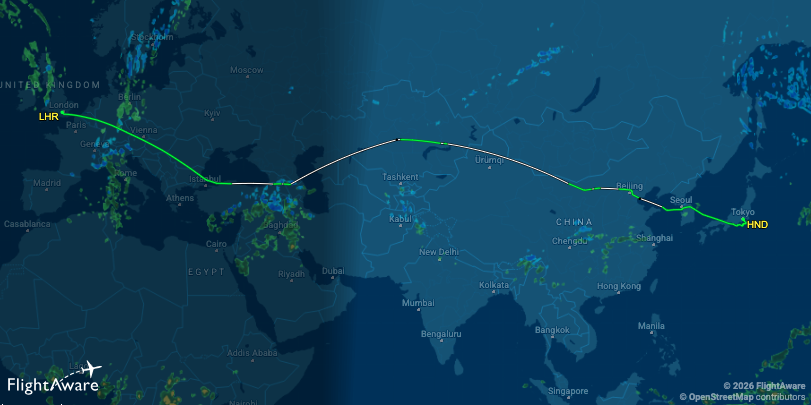
Major European Hub Airports. Passengers per year and per month:
| London Heathrow Airport | LHR | 84,464,000 | 7,038,667 |
| Istanbul Airport | IST | 84,458,000 | 7,038,167 |
| Paris Charles de Gaulle Airport | CDG | 72,029,450 | 6,002,454 |
| Amsterdam Schiphol Airport | AMS | 68,800,000 | 5,733,333 |
| Madrid Barajas Airport | MAD | 68,179,000 | 5,681,583 |
| Frankfurt International Airport | FRA | 63,189,700 | 5,265,808 |
| Barcelona El Prat Airport | BCN | 57,483,000 | 4,790,250 |
| Rome Fiumicino Airport | FCO | 51,307,000 | 4,275,583 |
| Munich Airport | LGA | 43,400,000 | 3,616,667 |
This redistribution is also reshaping airline competition. On the China–Europe corridor, capacity is projected to reach 12.1 million seats in 2026, up from 10.4 million a year earlier, with Chinese carriers now controlling around 83% of the market. European airlines, constrained by longer routings and operational limitations, are struggling to match this rapid expansion.
India is also emerging as a critical transit and growth market. Europe–India passenger traffic rose approximately 30% above 2019 levels in 2024, while India’s strategic geographic position is enabling carriers such as Air India and IndiGo to develop new connecting flows between Europe and Southeast Asia. With expanding fleets and network ambitions, Indian airlines are increasingly positioning Delhi and Mumbai as alternative hubs to the Gulf.
U.S.–Asia Travel Surging
Across the Atlantic, U.S.–Asia travel is accelerating sharply as airlines capitalize on shifting global demand patterns. Revenue passenger kilometers (RPKs) between North America and Asia reached approximately 23 billion in 2024, up from 20 billion in 2023, reflecting double-digit growth driven by capacity expansion and recovering long-haul demand. Overall passenger demand in the Asia-Pacific region rose 27% year-on-year in 2024, while North American carriers reported an 8.1% increase in traffic, highlighting strong transpacific momentum.
U.S. airlines, led by United Airlines, are benefiting from their extensive transpacific networks and reduced reliance on Middle Eastern airspace. As travelers increasingly avoid conflict-affected regions, booking patterns are shifting toward direct or Pacific-based routings, strengthening load factors and yields on U.S.–Asia services.
At the same time, Asia-Pacific carriers are aggressively expanding long-haul capacity to capture this demand. Airlines such as Singapore Airlines, Cathay Pacific, Japan Airlines, and ANA are increasing frequencies and restoring routes to Europe and North America, positioning themselves as stable alternatives to traditional Gulf hub connections. This shift is contributing to a broader redistribution of traffic flows across global aviation networks.
Gulf Airlines and Airports Lose Traffic as Hubs Bypassed
The biggest losers in this evolving landscape are Gulf carriers, which have traditionally dominated east–west traffic flows. Airlines such as Emirates, Qatar Airways, and Etihad Airways now face both operational challenges and changing passenger preferences as travelers seek more predictable routings.
Despite longer flight times and higher fuel costs, global demand for long-haul travel remains strong. International arrivals across Asia-Pacific reached 91% of pre-pandemic levels in 2025, signaling near-full recovery.
Airlines are responding by adding direct routes, increasing frequencies, and deploying more fuel-efficient aircraft. The result is a more diversified and resilient global network, less reliant on a single region and more adaptable to geopolitical shocks.
As tensions continue to influence airspace access, the global aviation map is being redrawn in real time. For airlines, airports, and passengers, this shift marks not just a recovery, but a transformation of how the world connects.
Related News: https://airguide.info/?s=middle+east, https://airguide.info/?s=Iran, https://airguide.info/category/air-travel-business/travel-health-security/
Sources: AirGuide Business airguide.info, bing.com, flightaware.com, IATA, ACI