
LaGuardia Crash Exposes Air Traffic Safety Failures

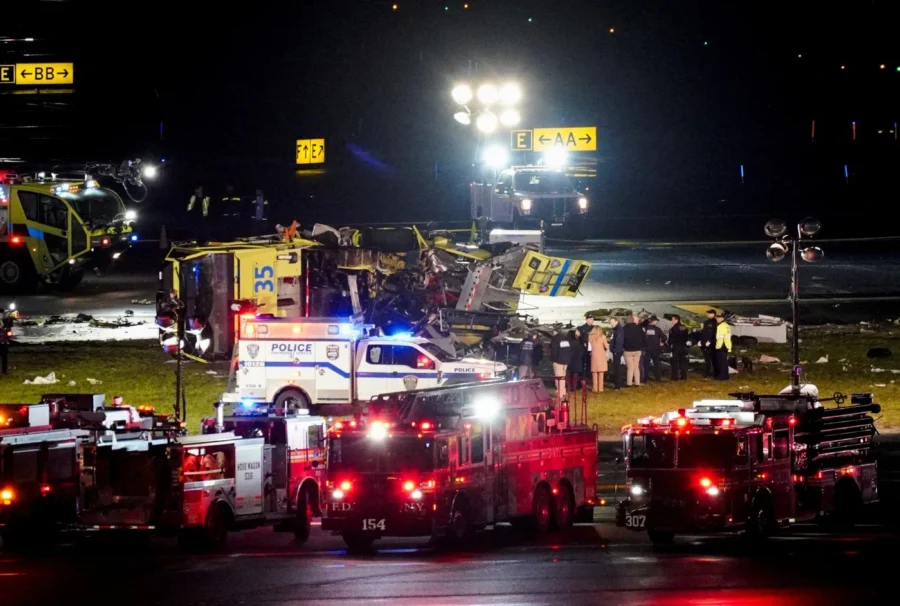
Long-standing safety concerns at New York’s LaGuardia Airport are under renewed scrutiny following a deadly runway collision that killed two pilots and injured dozens of passengers, raising urgent questions about air traffic control procedures at one of the busiest U.S. airports.
The crash occurred on March 23, 2026, when an Air Canada Express Bombardier CRJ-900, operated by Jazz Aviation, collided with a Port Authority fire truck while landing on Runway 04. The aircraft, carrying 72 passengers and four crew members from Montreal, suffered severe damage to its nose section, resulting in the deaths of both pilots.
The fire truck had been cleared to cross the runway to respond to a separate incident involving a United Airlines Boeing 737-8, which had reported a strong odor after two aborted takeoffs. According to preliminary information, the air traffic controller, reportedly handling both ground and tower duties, authorized the vehicle to cross but then issued urgent stop instructions as the aircraft approached on final descent. With the jet traveling at high speed, there was little time to prevent the collision.
Two Pilots Dead After CRJ-900 Runway Incident at LaGuardia
Federal investigators from the National Transportation Safety Board (NTSB) and the Federal Aviation Administration (FAA) have launched a full investigation. Both the flight data recorder and cockpit voice recorder have been recovered and will be analyzed to determine the exact sequence of events, the NTSB reported during a press conference on the evening of March 23, 2026. The process of reading out the recorders is set to begin on March 24, 2026.
The tragedy comes amid growing evidence of systemic safety concerns at LaGuardia. Over the past two years, pilots have filed multiple reports through NASA’s Aviation Safety Reporting System highlighting operational risks, including miscommunication, unclear instructions, and near runway incursions.
In one report, a pilot warned of increasing pressure on controllers, writing “Please do something” after a near-miss involving multiple aircraft and inadequate guidance.
Other reports describe aircraft being cleared to cross active runways while incoming flights were on approach, with last-second interventions preventing potential disasters. These recurring issues point to the challenges of managing high-density traffic at airports with complex runway configurations.
The LaGuardia crash also follows a series of recent aviation safety incidents. In October 2025, two Delta Air Lines regional jets collided on a taxiway at the airport, injuring one person. Just days before the fatal crash, another serious close call occurred at Newark Liberty International Airport involving aircraft attempting to land on intersecting runways.
Aviation experts say the latest incident highlights deeper systemic issues, including controller workload, communication breakdowns, and reliance on precise timing in congested airspace. The reported use of a single controller for both ground and tower operations is expected to be a key focus of the investigation.
Despite the severity of the crash, there were also reports of remarkable survival. One flight attendant was ejected from the aircraft but survived with serious injuries, an outcome experts described as extraordinary given the extent of the impact.
Lawmakers are now calling for immediate action. Senator Richard Blumenthal has urged federal regulators to review safety procedures and address systemic risks, warning that the findings could have nationwide implications for airport operations.
As the investigation continues, the LaGuardia accident is likely to reignite debate over air traffic control staffing, training, and runway safety protocols—issues that remain critical as U.S. air travel demand continues to grow.
Related News: https://airguide.info/?s=NTSB, https://airguide.info/?s=FAA, https://airguide.info/?s=Air+Canada, https://airguide.info/category/air-travel-business/travel-health-security/
Sources: AirGuide Business airguide.info, bing.com