
LaGuardia Crash Probe Delayed by Shutdown, TSA Lines

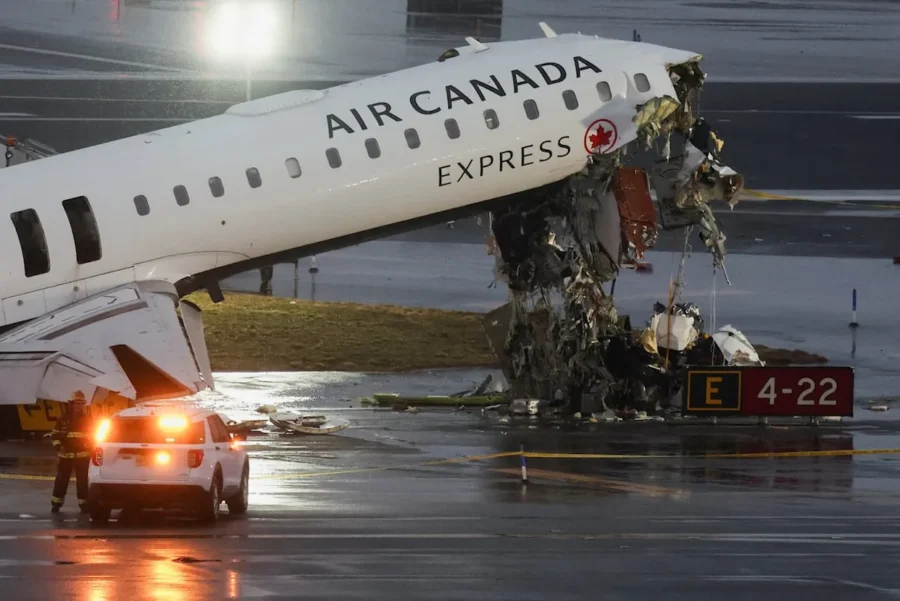
The investigation into the fatal runway collision at LaGuardia Airport that killed two Air Canada pilots has been slowed by federal government shutdown disruptions, highlighting broader challenges facing U.S. aviation safety and infrastructure.
The accident occurred late on March 23, when an Air Canada Express Bombardier CRJ-900, operated by Jazz Aviation, collided with a Port Authority fire truck while landing at New York’s LaGuardia Airport. The aircraft, arriving from Montreal with 72 passengers and four crew members onboard, sustained catastrophic damage, including a sheared-off nose section, resulting in the deaths of both pilots.
Federal investigators from the National Transportation Safety Board (NTSB) and the Federal Aviation Administration (FAA) quickly launched a probe into the incident. However, the early stages of the investigation were hindered by logistical challenges tied to the ongoing federal government shutdown.
NTSB Chair Jennifer Homendy said that long security lines at airports across the United States delayed the arrival of key investigative personnel. Some specialists faced hours-long waits at Transportation Security Administration (TSA) checkpoints, with one investigator reportedly stuck in a three-hour line before receiving assistance to proceed. “It has been a really big challenge to get the entire team here,” Homendy said, noting that investigators were still arriving more than 24 hours after the crash. The agency was unable to complete a full first day of investigative work due to these delays.
Despite these setbacks, investigators were able to recover the aircraft’s cockpit voice recorder, which remained intact and is expected to provide crucial insight into the moments leading up to the collision.
Preliminary findings suggest the fire truck had entered the runway while responding to a separate emergency involving another aircraft that had aborted takeoff. Air traffic control communications indicate the controller may have been managing multiple situations simultaneously, raising questions about workload and operational procedures.
The crash forced the closure of LaGuardia Airport for nearly 14 hours, disrupting operations at one of the busiest airports in the United States. The affected runway is expected to remain closed for several days as investigators continue to examine the site and collect evidence.
Passengers onboard described chaotic scenes following the collision, with some evacuating onto the runway as emergency crews rushed to respond. Survivors included a flight attendant who was ejected from the aircraft but found alive near the wreckage with serious injuries.
The incident also drew attention to ongoing staffing and operational pressures within the aviation system. On the same day as the crash, airports nationwide were experiencing long TSA security lines due to staffing shortages linked to the shutdown, further complicating travel and emergency response logistics.
Transportation Secretary Sean Duffy said LaGuardia remains a well-staffed airport overall, though officials acknowledged that further details about staffing levels at the time of the incident are still under review.
The LaGuardia collision marks one of the most serious aviation accidents at the airport in decades and is expected to prompt renewed scrutiny of runway safety, air traffic control coordination, and emergency vehicle operations on active airfields.
As investigators continue their work, the findings could have far-reaching implications for aviation safety policies across the United States, particularly at high-traffic airports where complex operations leave little room for error.
Related News: https://airguide.info/?s=NTSB, https://airguide.info/?s=FAA, https://airguide.info/?s=Air+Canada, https://airguide.info/category/air-travel-business/travel-health-security/
Sources: AirGuide Business airguide.info, bing.com, nytimes.com