
Middle East Air Travel Disruptions and Evacuations Ongoing

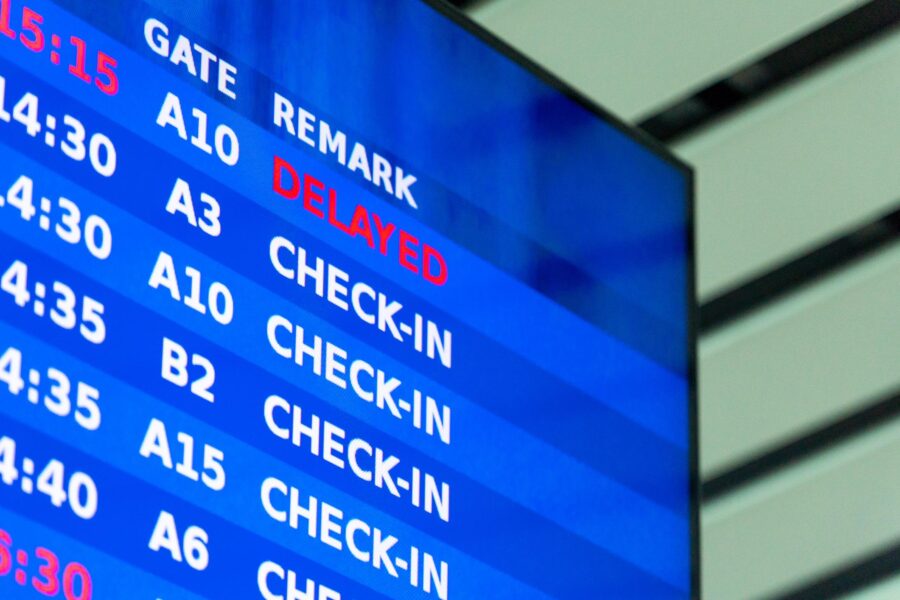
Air travel across the Middle East remains highly volatile after the escalation that began on February 28, 2026, following US and Israeli strikes on Iran and subsequent Iranian retaliation. Although portions of Gulf airspace have partially reopened, flight schedules continue to shift with ongoing cancellations, rerouting and strict capacity controls disrupting global traffic flows. In response, governments have launched large-scale evacuation and charter operations to assist an estimated 100,000 or more stranded citizens as airlines work to stabilize limited services across the region.
Airspace over parts of the United Arab Emirates, Qatar, Bahrain, Kuwait and sections of Saudi Arabia has experienced intermittent closures or severe restrictions. Major transit hubs including Dubai (DXB), Abu Dhabi (AUH) and Doha (DOH) have resumed limited operations, but airlines continue to operate reduced schedules, prioritizing repatriation and essential services.
Carriers such as Emirates, Qatar Airways and Etihad Airways have restored some long-haul routes, though delays and last-minute cancellations remain common. Qatar Airways has the most flights cancelled, followed by Gulf Air, FlyDubai and EgyptAir. European and Asian airlines are selectively resuming services, but many flights are being rerouted to avoid restricted airspace, increasing flight times and operational costs.
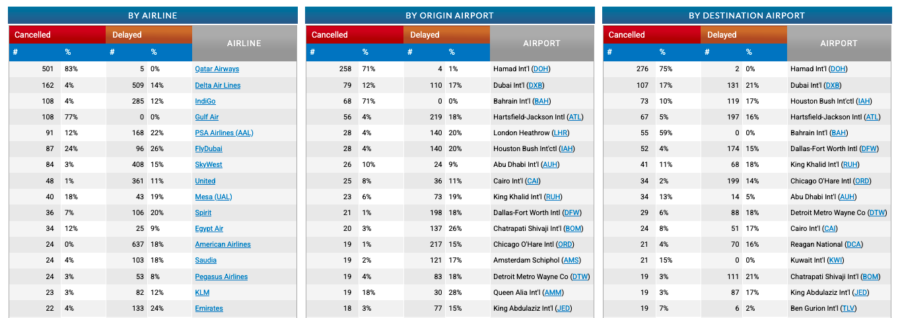
Flights Cancelled Today: https://www.flightaware.com/live/cancelled/today
Since the conflict began, tens of thousands of flights have been canceled or delayed across the region, with ripple effects spreading to Europe, Asia and North America due to the Gulf’s critical role as a global transit corridor. On peak disruption days, thousands of flights have been canceled worldwide as airlines adjust to shifting airspace advisories. Governments have launched large-scale evacuation operations to assist an estimated 100,000 or more stranded citizens across the region.
Governments have Launched Evacuation to Assist Stranded Citizens
The US State Department has confirmed ongoing repatriation efforts, while European and Asian governments are coordinating special flights to extract nationals from affected hubs. Based on the latest available reporting and government updates. Numbers remain fluid and are rising as more departures are completed:
Americans
More than 32,000 U.S. citizens have returned home since the conflict began on February 28, 2026, according to the U.S. State Department. Earlier official figures noted over 17,500 Americans had been evacuated, with thousands departing in a single day during peak repatriation operations.
Europeans and Other Countries
Exact pan-European figures are not centrally published, but government sources and tracking data indicate large numbers of European travelers have returned via charter and commercial flights. A charter flight for Irish citizens alone was organized to evacuate about 280 people.
Reports compiled from evacuation initiatives show tens of thousands of stranded Germans and Italians were seeking departures, with Germany citing roughly 30,000 nationals affected and Italy planning to assist up to 58,000 citizens in returning from the Gulf.
France noted it has hundreds of thousands of nationals in the Middle East who may require assistance, though an exact departure count has not been published.
Indians
The Government of India reported that over 52,000 Indian nationals were flown home from the UAE and other Gulf countries within one week of evacuation operations.
Other Asian Nationalities
While consolidated figures for Chinese, Filipino and Southeast Asian citizens are not yet available, official reports emphasize that tens of thousands of Asian travelers remain stranded or in transit hubs due to flight cancellations and reroutes. This includes large communities of Indians, but no single aggregated count has been publicly released for other Asian nationalities.
Overall Impact
Independent industry estimates and government statements repeatedly describe “hundreds of thousands of travelers” across all nationalities affected by flight disruptions, cancellations and airspace closures since late February.
Transit passengers traveling between Europe and Asia via Gulf hubs such as Dubai International Airport, Hamad International Airport and Abu Dhabi International Airport are among the most severely impacted.
Summary (Approximate Evacuation Figures):
• United States: ~32,000 evacuated
• India: ~52,000 evacuated
• Ireland: ~280 evacuated via charter flights
• Germany: Tens of thousands impacted and in evacuation planning
• Italy: Planned evacuations for tens of thousands
Evacuation figures continue to change as governments expand charter programs, restore limited commercial services and arrange overland or third-country transfers. The full scope of how many travelers remain in transit or stranded will become clearer only as foreign ministries, aviation authorities and airlines release updated data in the coming days.
While precise totals remain uncertain, industry analysts estimate that hundreds of thousands of passengers from multiple nationalities have been affected at different stages since late February. Travelers transiting between Europe and Asia through major Gulf hubs have faced some of the most severe disruption, as sudden airspace closures triggered widespread missed connections, cancellations and cascading schedule breakdowns.
Security analysts report missile and drone activity in parts of the region, though commercial aircraft are operating under strict airspace monitoring and military coordination. Airlines continuously assess Notices to Air Missions (NOTAMs) and intelligence updates before dispatching flights.
Travelers planning journeys through the Middle East are advised to:
• Monitor airline notifications closely
• Expect potential schedule changes or rerouting
• Confirm connections before departure
• Check government travel advisories
• Consider flexible ticketing options
While limited stabilization has occurred in some air corridors, the situation remains dynamic. Airlines, regulators and air navigation authorities continue to coordinate closely as geopolitical tensions persist, and full normalization of Middle East air travel may take weeks depending on further developments.
Related news: Live Tracker: Airport and Flight Delays – Middle East Air Travel Chaos as Iran Attacks,
https://airguide.info/category/air-travel-business/travel-health-security/
Sources: AirGuide Business airguide.info, bing.com