
NASA CATNLF Wing Completes First Flight on F-15 jet

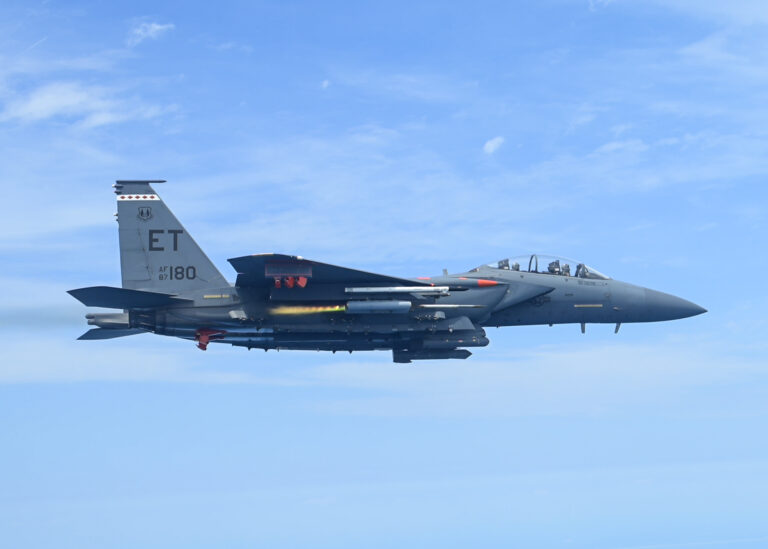
NASA has completed the first flight test of a scale-model wing designed to improve laminar flow, a smoother airflow that reduces drag and fuel consumption in future commercial aircraft.
The flight took place Jan. 29 at NASA’s NASA Armstrong Flight Research Center in Edwards, California. Engineers mounted the 40-inch Crossflow Attenuated Natural Laminar Flow (CATNLF) wing model vertically beneath one of the agency’s F-15B research jets, positioning it like a fin under the fuselage.
The 75-minute mission focused on ensuring the aircraft could safely maneuver with the roughly 3-foot-tall test article attached. Pilots conducted a series of turns, steady flight holds and gentle pitch changes at altitudes ranging from about 20,000 to nearly 34,000 feet. The results confirmed stable handling and provided an initial look at the wing model’s aerodynamic performance.
“It was incredible to see CATNLF fly after all of the hard work the team has put into preparing,” said Michelle Banchy, the project’s principal investigator. “Finally seeing that F-15 take off and get CATNLF into the air made all that hard work worth it.”
NASA developed CATNLF technology to maintain laminar flow over swept-back wings, which are common on commercial airliners and fighter jets. On such wings, crossflow instabilities can disrupt smooth airflow, increasing drag. By attenuating those disturbances, CATNLF aims to preserve laminar flow for longer distances across the wing surface, potentially lowering fuel burn and operating costs.
This was the first of up to 15 planned research flights. The initial sortie centered on envelope expansion, verifying the structural integrity and dynamic behavior of the wing model before advancing to more demanding research maneuvers.
To measure laminar flow during flight, engineers used multiple diagnostic tools, including an infrared camera mounted on the aircraft and aimed at the test article. The camera collected thermal data that reveals subtle changes in airflow patterns. Researchers will compare the flight data with predictions from computer models and earlier wind tunnel, ground and high-speed taxi tests.
Early results indicate that airflow over the model closely matched preflight simulations, an encouraging sign for the technology’s viability.
“CATNLF technology opens the door to a practical approach to getting laminar flow on large, swept components, such as a wing or tail, which offer the greatest fuel burn reduction potential,” Banchy said.
The CATNLF effort is part of NASA’s broader aeronautics research portfolio aimed at improving aircraft efficiency and reducing emissions. Continued flight testing will further validate the design and assess its potential application to next-generation commercial aircraft.
Related News: https://airguide.info/?s=NASA,https://airguide.info/category/air-travel-business/aircraft-finance/
Sources: AirGuide Business airguide.info, bing.com