
WindRunner Cargo Jet Could Reshape Military Airlift

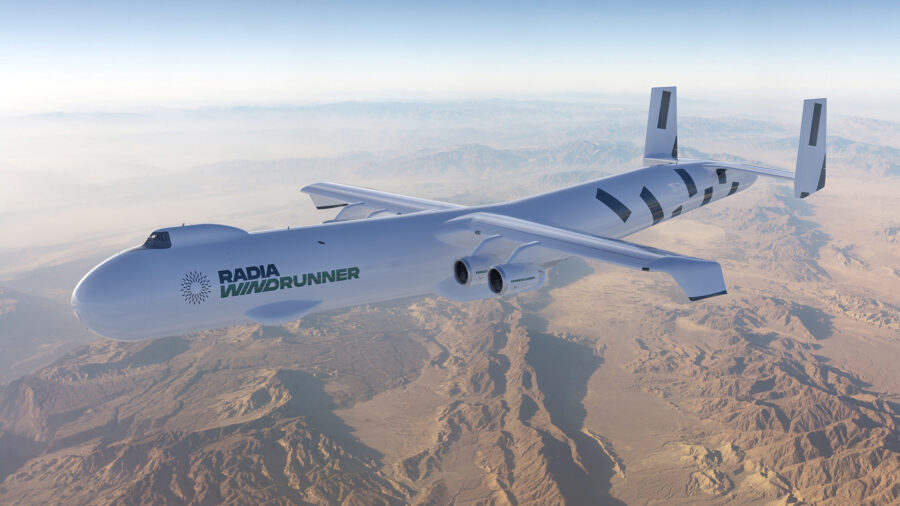
The team behind the Radia WindRunner says the aircraft’s unprecedented scale could transform both military and civilian heavy-lift operations.
With a projected range of approximately 2,000 to 3,000 miles depending on payload, the WindRunner is designed to transport oversized cargo directly to remote or austere locations, reducing reliance on traditional long, paved runways. Measuring 109 meters in length, it is positioned as the largest purpose-built cargo aircraft ever proposed, offering an internal volume estimated to be about twelve times greater than a Boeing 747-400F.
The aircraft’s expansive payload bay is engineered to accommodate exceptionally large equipment. According to its developers, the WindRunner could transport up to six fully assembled CH-47 Chinook helicopters in a single mission, without removing rotor blades or major components—an unprecedented capability in strategic airlift.
Mel Johnson, Radia’s vice president of regulatory affairs, described the aircraft’s scale as transformative. While traditional military airlift planning often focuses on payload weight, he noted that many missions are constrained by cargo volume rather than mass. Helicopters such as the Chinook typically “volume out” before they “weight out,” limiting how many can be transported at once on existing aircraft.
Currently, military heavy lifters such as the Boeing C-17 Globemaster III require partial disassembly of helicopters before transport. A Chinook carried on a C-17 must have its blades removed, a process that can take two days to dismantle and up to five days to reassemble, requiring specialized personnel and follow-up functional checks.
Radia says the WindRunner eliminates that inefficiency. The aircraft’s cavernous cargo hold could also accommodate up to four fully assembled F-35 fighter jets, allowing aircraft to “roll on ready and roll off ready,” significantly reducing turnaround time.
Though Radia primarily operates in the renewable energy sector and originally developed the WindRunner to transport large wind turbine components, defense applications have attracted attention from US military planners. With production of the C-17 having ended more than a decade ago, strategic airlift capacity has become a growing concern.
Despite its size, Radia claims the WindRunner will not require massive, specialized air bases. That flexibility could align well with NATO’s agile combat employment strategy, enabling rapid deployment of equipment to dispersed or forward operating locations.
Executives argue that faster turnaround and reduced ground handling time could enhance operational readiness. By moving fully assembled aircraft and helicopters directly into theater, forces could accelerate deployment cycles and minimize logistical bottlenecks.
Beyond its clear military applications, including rapid deployment of heavy equipment, strategic airlift missions, and humanitarian or disaster-relief operations, Radia emphasizes the aircraft’s commercial potential. The WindRunner is specifically tailored to support the renewable energy sector, where transporting full-length wind turbine blades and large tower sections remains a significant logistical challenge. Current air transport solutions cannot accommodate such cargo without extensive disassembly, while sea and land routes can be slow and geographically constrained.
Additional civilian applications could include transporting large industrial modules, space-industry hardware, and critical infrastructure components to isolated regions. By enabling point-to-point delivery of oversized cargo at scale, the WindRunner concept aims to bridge a longstanding gap in global heavy-lift logistics.
Radia is targeting a first flight in 2029. If successful, the WindRunner could represent a new category of ultra-large cargo aircraft, bridging the gap between traditional military transports and sealift capabilities while offering a potentially faster alternative to carrier-based repositioning of combat-ready assets.
Related News: https://airguide.info/category/air-travel-business/air-cargo/
Sources: AirGuide Business airguide.info, bing.com, forcesnews.com/